The death of open channels
How can we continue to discern relevancy in the age of AI?
Human interaction on the internet used to feel genuine, explorative, exciting. Social media taken to an extrem to farm engagement has thoroughly changed this many years ago. Big platforms turned into attention sucking machines that sold human interaction to advertisers. Though at this point, the creation of the content that was produced on those platforms was fundamentally human made with actual human work. While sloppy content / spam existed, it was easily discernable. And a good piece of content (besides damaging engagement farming, think clickbait thumbnails, fake titles, sexualised content) required genuine human craft and dedication to get engagement.
Fast forward to today, this is not the case anymore for the majority of platforms that are used for “social” exchange. AI has commodified what was once human-produced content. And everyone that is not blind can see this. While you can find human-made content online, and this being greatly cherished by the consumers of this content, we can be less and less sure about the human production side of this content. These consumers are also increasingly seeing “engagement” underneath posts that does not seem genuine. While spammy bots have always been present, a whole suite of companies and tools (that deploy LLM APIs) promise automized and fitting engagement. Thank god companies and their representatives finally do not have to directly engage with the people they want to sell to.
Companies and platforms that are supposed to create a space for humans to exchange are fighting bots with all their might. Also because humans see this and they care about it. Complaints on the sloppification of social media feeds are everywhere. Sadly, though, in the eternal game of cat and mouse, bots are seemingly edging ahead. Bot-detection systems and spam-filters are struggling. And there we have it: the dead internet (theory). While this dynamic is not new, the current acceleration is palpable.
The great sloppification
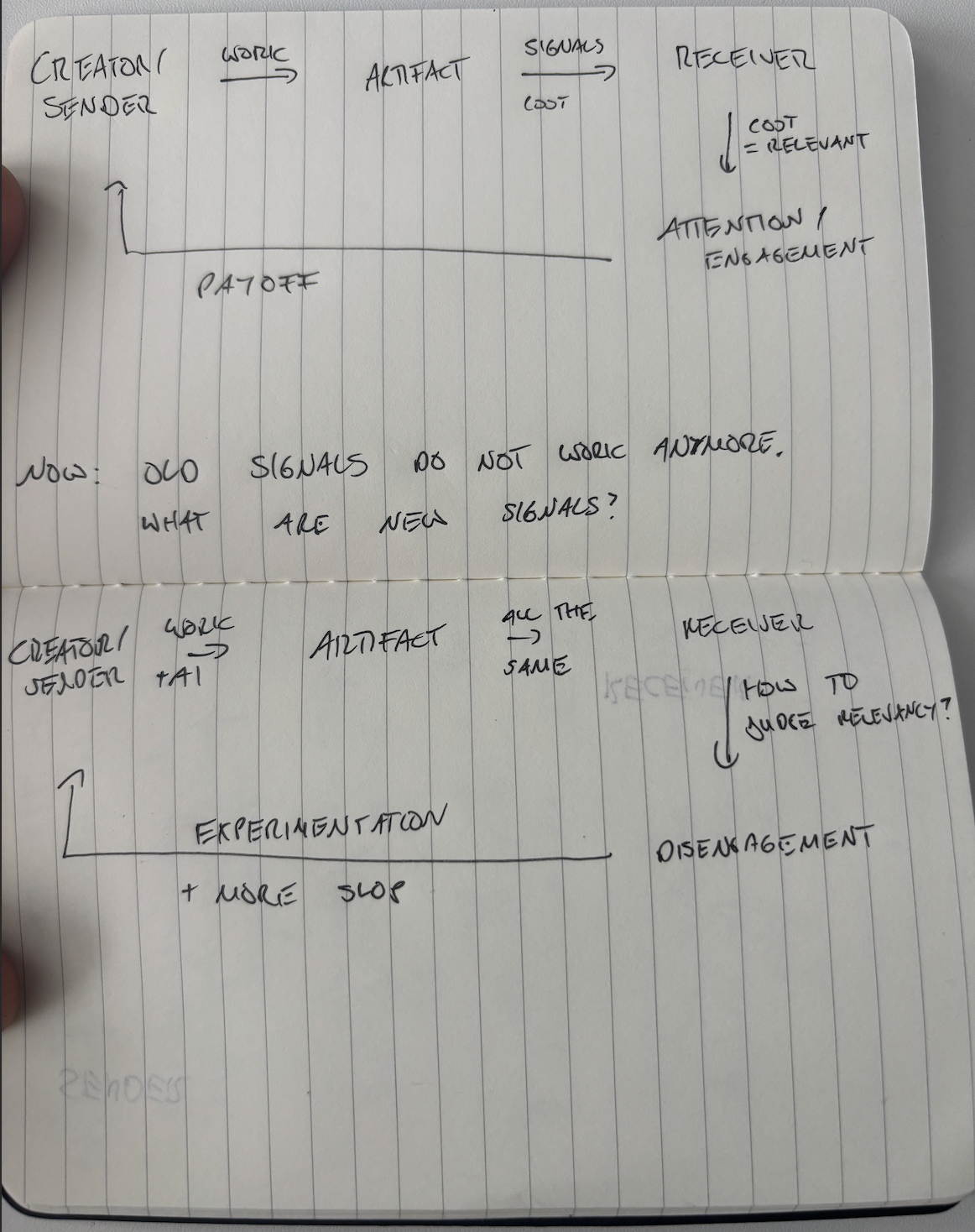
The underlying pressure that leads to this is classic market dynamics. Matching one party with another at the right time and with the right narrative is, afterall, challenging. And the base of many a business. Now couple this with the cost of creating and also sending something inching towards zero and you get the move towards sloppyfication. The proxy that a well crafted video was probably human-made, does not apply anymore (or will not in the near future). A highly customized email used to signal genuine engagement, for example with one’s prior work - not anymore. The process that is required to discern human-madeness (if this is even a word), quality, and then by proxy relevancy cannot rely on these signals anymore. The receiver of highly plausible seeming slop (be it in their inbox, feed, wherever) will have to wade through a knee-deep maelstrom of content to find what they deem relevant at this point.
Senders are also aware of this dynamic. They (and hundreds of gurus selling their outreach courses) are aware how fleeting the attention of the relevant target for outreach is, because they see so much stuff. They seek ever more ways to “stand out”. Custom pictures with messages, for example (that turn out to be fake). Sending calendar invites instead of emails (that turn out to be enraging). Mailing post cards (that are fake handwritten). Using fax-machines (that are apparently still standing around in some offices), tv-show style branding to stand out from the crowd (which are fun, I guess?). While receivers in many cases appreciate “the hustle” and novel, clever ways of getting in contact with them, they mostly appreciate being able to use their time effectively and efficiently. And many of these avenues are simply sucking energy and time out of the receivers.
Arguably, on the social networking end, we see this live. This feels like the good ol’ transition from social media platforms being used by early adopters (e.g., teens) to their parents (hi facebook, also hi Instragram). This is a tell-tale sign that these platforms are not on an upward trajectory anymore. What is visible currently is the retraction of open platforms into more private circles, for example using apps like BeReal (a couple of years back), retro, locket, and the like. But what happens to open platforms if they want to retain their human users?
Somehow proving that you are somewhat human?
Systems for open platforms that are tried and tested include reputation based systems. Ever since Reddit has become the defacto source of what LLMs regard as plausible and relevant information (bc, the theory goes, this is genuine human content. Look at google autocomplete when you type in looking for product recommendations, for example) the platform has experienced more and more pressure from bots. It’s automated and human mods are doing a great job. But the strongest protector against subreddits full of shilling seem to be user reputation. In many subreddits, you have to earn your right to post anything. Again, markets and bots find a way. You can buy aged and reputation-heavy reddit accounts, for example.
Drawing from other streams of tech, one could think about establishing relevancy by proof-of-work or proof-of-stake principles. We could think about introducing friction in the process of reaching out / publishing X / creating Y that is difficult or costly to automate or hand over to bots. The latest iOS update ships with a phone screener that asks incoming callers about the purpose of their call. In the world of websites this can be linked to a CAPTCHA, for example. There are other avenues for proof of work that could be slotted in here. In proof-of-stake land, we could think about attaching payments to outreach. If a sender is willing to stake 50$ on a message being relevant at the risk of losing the money if this is deemed a waste of time, this could be quite the incentive. For disclosure: I have played around with a crude idea to productise this in the form of captchainbox. The tool lets you set up a captcha or a pay-to-deliver mechanism for unknown senders to get into your inbox.
Ofc there are also other approaches that are being thrown around, things like the world coin (maybe some other examples) that seek to establish that one actual human did X. I guess this is seeking to tackle the same problem.
So where is the place for humans?
One might ask. All of these measures and ideas hinge on human-made things to be relevant. And some of these measures also render the open internet less open. In a future in which the internet is merely about bots conversing and doing business, ofc humanness does not matter as much. Even if I believe bots will also have a hard time discerning the relevancy of things. And they, too, will try to figure out what signals they can look for to establish that relevancy (see the entire SEO/GEO sector). LLMs being trained on human data would probably look for many of the things humans look for. And they also have to draw their information from somewhere.
I suspect that, in the absence of adequate (e.g., accepted and feasible) signals for humanness and relevancy, humans will be drawn to more analogue spaces. For example, I have never seen as many people flocking to in-person tradefairs as these days. I also did not know just how many of these exist (just look at the list of solar energy tradefairs these days, damn). If all of the above actually becomes true, markets will also shift to cater to this to take advantage of arbitrage opportunities. Open channels on the internet / phone are seeing saturation kick in imho. I suspect that the next wave of wearables in combination with near real-time ai capabilities will start appearing in these new, analogue spaces (for arbitrage), examples of which we have already seen (e.g., Pocket, AI Pins of various couleur).
In any case, humans will continue seeking out places that feel like genuine human connection is possible, wherever that might be.
← more musings